
Gettin' My Eps In: The Lowdown S1E7
When building to a momentous finale, an abrupt cliffhanger is both fitting and aggravating.

The Lowdown
Season 1, Episode 7: “Tulsa Turnaround”
Written by Walter Mosley
Directed by Danis Goulet
Streaming on Hulu/Airing on FX
I may have mischaracterized this series as a Raymond Chandler-style noir. In the latter half of the season, it has become less of a series of oddball adventures and more of a focused narrative, barreling toward what seems likely to be a violent conclusion. However, this structure is no less entertaining and enthralling, and as the big picture of what has been happening comes together, it has set up a pretty clear-eyed moral conflict that positions people fighting for justice in opposition to villains who are pretty obviously evil in a way that’s sadly true-to-life in 2025.
As mentioned in the discussion of the previous episode, the people who are behind the shadowy goings-on that Lee Raybon (Ethan Hawke) has been investigating are a church that not only preaches a white supremacist message, but has been gathering a small army of violent criminals in preparation to establish a new community on land that is being purchased from the Washberg family. The opening of this episode underscores the fact that these actions fit comfortably into American history by cross-cutting between the church’s preacher giving a sermon that espouses the importance of white people seizing control of the land that they believe rightfully belongs to them and gubernatorial candidate Donald Washberg (Kyle MacLachlan) kicking off a local celebration of Oklahoma history in which kids dressed in pioneer costumes reenact the Oklahoma land rush of 1889, in which the government gave away a bunch of Native American land to white settlers.
It’s a striking comparison that makes for a nice demonstration of the staunch refusal of the United States to reckon with our ugly past. On the one hand, some people with beliefs that most of us would find loathsome are shown to mostly be regular folks, claiming that they’re just doing what they believe is necessary to protect the future of their children. On the other hand, we have a celebration of an event in American history that was based on white supremacist exploitation of people with less power. Many people would have the same response that Donald Washberg has here when confronted by Native American protestors, claiming that it’s just a fun event that recognizes something that happened in the past, and it doesn’t have any relevance to today. But it obviously does; when our country is filled with monuments to and celebrations of historical figures who engaged in slavery, genocide, and exploitation, is it any surprise that people in modern society are still hanging on to disgusting, backward beliefs about the superiority of white people and the less-than-fully-human status of other races?
Now that the details of the nefarious plot Lee has been investigating have become clear, the question is what he’ll actually do about it. In one of the aggravatingly short-sighted moves that he has become known for throughout this season, he informs Betty Jo Washberg (Jeanne Tripplehorn) of the existence of her late husband’s will, which had granted his share of the Washberg family land to some Native American friends of his. She promptly sells him out to Frank (Tracy Letts), the guy who is facilitating the land deal with the white supremacists.
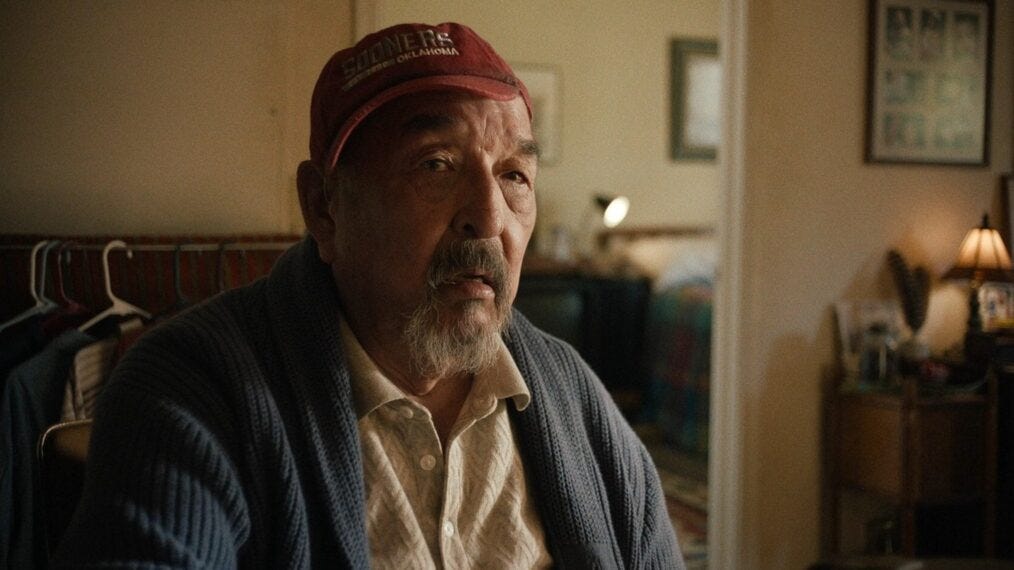
This leads to a pretty harrowing confrontation between Frank and Arthur (Graham Greene), the elderly Native man whose family originally owned the land but was screwed out of it by murderous white people. In one of Greene’s final roles (he died in September 2025), he delivers a heartbreaking performance as a man with dementia who doesn’t understand the questions that Frank is asking him about the will but slowly comes to realize that this is yet another white man who is exploiting him and his people. And predictably, the situation leads to the worst possible results.
All of this makes one question the efficacy of Lee’s actions and whether he’s really a good man. This becomes a concern for him during this episode as he gets excited about the big expose he’s going to write about the Washberg family, their dealings with white supremacists, and the ways they’ve screwed over the Native American community. He has visions of winning the Pulitzer Prize and being recognized as the person who broke the next Watergate-style scandal.
However, Lee also wants to believe that he’s a crusader for justice. He spends some time driving Cyrus (Killer Mike), the publisher of a local newspaper, around, and Cyrus talks about making a difference for the community and standing up against white supremacy. When the two of them visit Cyrus’s cousin, a lawyer who may be able to help enforce Dale Washberg’s will, Lee gets questioned about what he’s getting out of the situation, and he can barely manage to come up with a motivation that’s vaguely similar to what Cyrus had been talking about. It’s enough to get the lawyer on board, but it’s a remarkably weaksauce explanation of Lee’s motivations.
And then there’s the issue of Lee’s failures as a father. While his daughter Francis (Ryan Kiera Armstrong) obviously looks up to him and wants to be involved in his investigations, he keeps shutting her out due to concerns that he could put her safety at risk. When he shows up late for a parent-teacher conference and then walks out because his ex-wife brought her fiancé along, Francis gets upset that he’s not only failing to involve her in his professional life, but he’s also failing to show up as a father. He tells her that he wants her to be proud of him, which is why he’s so focused on his journalistic activities, but she just wants him to be her dad. Does this get him to make any changes? Nope, he’s off to continue his investigation, which is going to put him in even greater danger.
In the midst of all of this, the question remains about whether Lee’s actions are actually beneficial to the people whom he claims to be defending. Arthur and his grandson had Dale’s will, and they knew that they may have a right to their ancestral land, but they also knew that attempting to fight the system would be impossible, only leading to heartbreak when their people got screwed over yet again. But Lee, believing that he was fighting for justice, took actions that brought them to the attention of powerful people with murderous intent. The results were all too predictable.
That’s one of the questions that this show is wrestling with: is it worth it to stand up to the powerful forces that seek to subjugate others and consolidate control? For most people, the answer to that question would be “yes,” since it’s important to prevent tyranny and stop people from engaging in violence against the marginalized segments of society. But for people in those marginalized communities, actions taken against people in positions of power and authority will most likely end up inviting additional violence and subjugation. Balancing the protection of people’s rights with the need to maintain safety and stability can be difficult. Lee has no conception of this balance, and even though he believes he’s doing the right thing, it seems like his battles for justice are going to have plenty of collateral damage.
While the show may not provide any definitive answers to the various questions it has raised, it provides some fascinating explorations into the issues that are all too relevant to people in the increasingly oppressive atmosphere of the United States. And it’s also pretty damn exciting, with this episode ending on a cliffhanger that makes one want to immediately watch the season finale to find out how Lee is going to get out of a predicament in which it certainly seems like violence is inevitable. Whether things can be wrapped up in a satisfying manner remains to be seen, but based on the strength of the season as a whole, it’s likely to be a memorable conclusion.
THE Walter Mosley wrote the episode?